
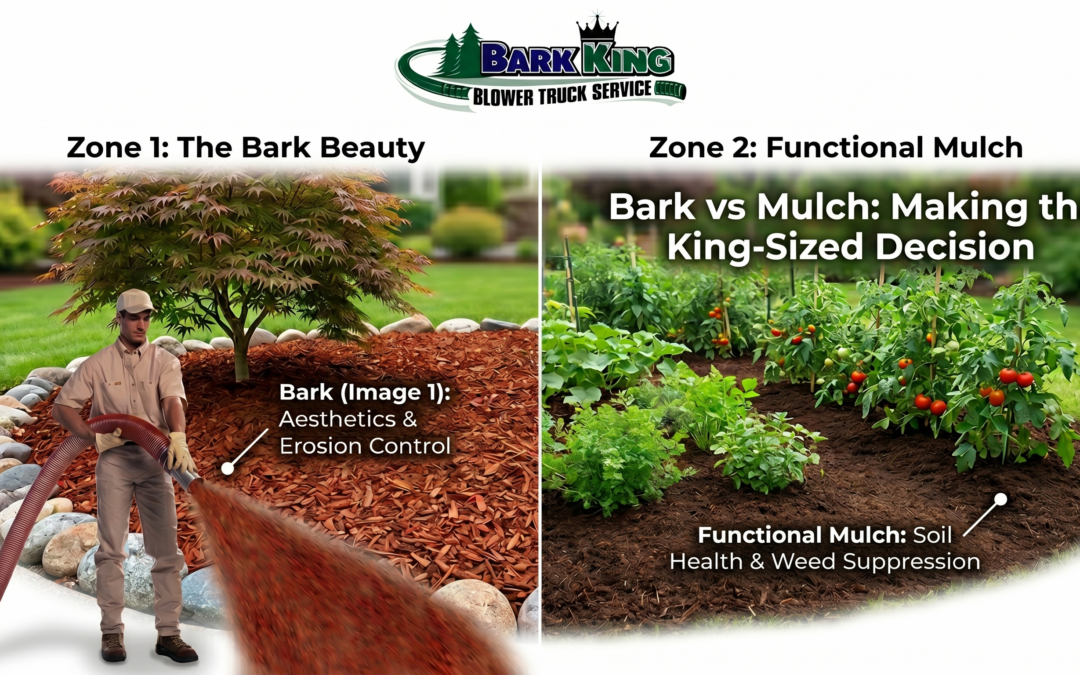

Bark vs. mulch is one of the most common questions we hear from Eastside homeowners — and it is a good one. Whether you are refreshing the front beds in Bellevue, Kirkland, or Redmond, the material you choose affects how your yard looks, how much weeding you do, and how often you have to top it up.
They look similar and both go on top of your soil to protect your plants, but bark and mulch are not the same thing. Choosing the right one can be the difference between a landscape that thrives all year and one that is fighting weeds and dry soil by mid-July.
Here is a straightforward, no-nonsense breakdown from the Bark King crew — based on what we actually install every day across the Greater Eastside — so you can pick the right material with confidence.
What’s Actually the Difference Between Bark and Mulch?
It’s a fair question, because the two terms get mixed up all the time.
Bark is exactly what it sounds like: the outer layer of a tree, shredded or chipped into pieces. In the Pacific Northwest, that usually means Douglas fir or hemlock bark. It’s chunkier, longer-lasting, and tends to look cleaner for longer.
Mulch is a broader category. Any material you lay on top of soil to protect it can be called mulch — that includes bark, but it also includes fertile composted mulch, wood chips, leaf mold, and more. In our world, when homeowners say “mulch,” they usually mean a darker, richer, more organic material like our Royal Mulch or certified organic compost.
So bark is a type of mulch, but not all mulch is bark. Simple.
When Bark Is the Better Choice
Bark is our go-to recommendation when the priorities are longevity and curb appeal.
Our Medium Bark is the most popular pick for Eastside homeowners — it’s got a rich color, a natural texture, and it stays put. For more refined beds around the entryway, Fine Bark gives a tidier, more manicured finish.
When Mulch Is the Better Choice
Mulch — especially our fertile mulch and compost blends — is the right call when the goal is feeding your soil and helping plants thrive.
🌱 Choose mulch if:
- You’re working in vegetable gardens, flower beds, or around newly planted shrubs and trees.
- Your soil is compacted, sandy, or low in organic matter (common in new construction yards).
- You want nutrients to break down into the soil over the season.
- You’re okay refreshing the top layer every year or so as it decomposes.
Our Royal Mulch is hands-down the favorite for this — it’s dark, it conditions the soil, and it looks great while it’s doing the work. For pure soil amendment, our certified organic compost is the right product.
Compare Eastside Costs: Bark vs. Mulch
Pricing changes seasonally and by material, but here’s the general rule:
- Bark costs a little more per cubic yard, but because it lasts longer, the cost per year often comes out about even.
- Fertile mulch and compost are typically less expensive up front but need replenishing more often as they break down into the soil.
The best way to compare apples to apples is to figure out how many cubic yards you actually need. Our material calculator does the math for you — just enter your bed dimensions and desired depth.
What About Installation?
Here’s the part most homeowners underestimate: moving bark or mulch by wheelbarrow is brutal work. A standard residential bed takes 3–10 cubic yards of material. That’s dozens of wheelbarrow trips, hours of shoveling, and — if you’re on a slope or in a backyard bed — a back-breaking weekend.
This is exactly why we built Bark King around blower truck service. Instead of dumping a pile in your driveway and leaving you to haul it, we blow the material directly into your beds through a hose — even over fences, around tight corners, and onto slopes you couldn’t wheelbarrow to if you tried.
If you’re curious how it works, our blower truck advantage page walks through the whole process.
So Which Should You Pick?
Here’s the quick Bark vs Mulch version:
- Front yard, curb appeal, low maintenance → Medium Bark or Fine Bark.
- Vegetable beds, new plantings, soil that needs help → Royal Mulch or Compost.
- Slopes, erosion-prone areas → Bark (heavier, stays in place).
- Playgrounds or play areas → Neither — you want ADA Certified Playchips instead.
Most Eastside yards end up using both — bark in the visible front beds and mulch or compost in the working garden areas. There’s no rule that says you have to pick one.
Ready to Get Started?
If you know what you need, use our material calculator to figure out the quantity, then reach out for a free estimate. We service Bellevue, Kirkland, Redmond, Sammamish, Issaquah, Woodinville, and the rest of the Greater Eastside — and we can usually schedule within a week during the spring season.
Still not sure which material is right for your project? Give us a call. We’ve been doing this long enough to tell you what will actually work for your yard — not just what we have a truck full of.
Frequently Asked Questions
Is bark the same as mulch?
Not exactly. Bark is one type of mulch. Bark is the shredded or chipped outer layer of trees (usually Douglas fir or hemlock here in the Pacific Northwest), while mulch is a broader term for any material laid on top of soil, including fertile composted mulch and compost. So all bark is mulch, but not all mulch is bark.
Which lasts longer, bark or mulch?
Bark lasts longer. A bark application typically holds its look for 1 to 2 years before needing a refresh, while fertile mulch and compost break down faster because they are designed to feed the soil, so they usually need topping up every year or so.
Is bark or mulch better for a vegetable garden?
Mulch or compost is the better choice for vegetable beds and new plantings. These materials break down and add nutrients and organic matter to the soil over the season. Bark is better suited to visible front-yard beds where a clean, long-lasting look matters most.
How much bark or mulch do I need?
A standard residential bed usually takes 3 to 10 cubic yards. Our step-by-step coverage guide walks you through the math, or you can run your numbers straight through our material calculator. Note that Bark King has a 10 cubic yard minimum for delivery.
What is blower truck installation?
Instead of dumping a pile in your driveway, Bark King blows bark, mulch, compost, or playground chips directly into your beds through a hose. This reaches over fences, around tight corners, and onto slopes you could not easily wheelbarrow to, leaving a smooth, even finish with no wheelbarrow tracks. Learn more on our blower truck advantage page.
Is bark good for playgrounds or play areas?
No. For play areas you want ADA Certified Playground Chips rather than standard bark or mulch. Playchips are designed for safety and impact absorption under play equipment, which regular bark and mulch are not.
What areas does Bark King serve?
Bark King has served the Greater Eastside since 2004, including Bellevue, Kirkland, Redmond, Sammamish, Issaquah, Woodinville, and surrounding communities. During the busy spring season we can usually schedule within about a week.
Still deciding between bark and mulch? Call the King at 425-814-6444 for a free estimate — our team will tell you exactly what will work best for your yard.


Call us today!
425-814-6444
Let's plan your next project!
Our office staff is exceptionally knowledgeable and experienced. We work tirelessly to ensure that the experience our clients have is positive! Understanding client's needs allows us to provide assistance in selecting the appropriate material.
We schedule jobs in a manner that ensures the entire process goes smooth and deadlines are met. We understand the unique requirements of individual job sites!